Authenticity is No Longer a Strategy. It’s a System.
We are entering a phase where the distance between what is said and what is true is collapsing. Not gradually. Structurally.
The recent Latent controversy, the public reactions to creators like Samay Raina and BeerBiceps, and the increasing scrutiny of brands for inconsistent products across markets, such as debates around Costco rotisserie chicken, are not isolated events.
They are indicators of a deeper shift. A shift from perception-driven trust to evidence-based trust.
1. The Collapse of Perception as a Standalone Strategy
For decades, brands and individuals operated under a simple but powerful assumption:
If you control perception well enough, you control trust. This led to:
- Carefully curated identities
- Highly controlled messaging
- Consistency optimized for appearance, not alignment
The system worked because information asymmetry existed. Brands knew more than consumers. Creators controlled what was visible. That asymmetry is gone.
Today, consumers:
- Compare ingredients across countries
- Validate claims through peer networks
- Cross-check narratives in real time
Trust is no longer built on what is communicated. It is built on what can be verified. This is why inconsistencies, however small, scale disproportionately. Not because people are reactive. But because misalignment is now visible.
2. The Evolution of Consumer Behavior: From Audience to Auditor
The modern consumer is not passive. They are investigative. Three structural changes define this shift:
a. Access to Information
Product labels, global comparisons, Reddit threads, and independent reviews have created a system where brand claims are constantly tested.
A brand is no longer compared to its competitors. It is compared to its best version in another market.
b. Decline of Institutional Trust
There is a growing skepticism towards corporations, media, and centralized narratives.
People trust:
- Individuals over institutions (Food Farmer, Testing, Individual Quality checks and Claims)
- Communities over campaigns
- Experience over messaging
c. Rise of Peer Validation
Validation no longer comes from authority. It comes from relatability. “What are people like me saying?” has replaced “What is the brand saying?” The result is clear: Consumers are no longer audiences. They are auditors of authenticity.
3. The Influencer Crisis: When Persona Stops Scaling
The influencer economy was built on a fundamental principle: Consistency builds trust. A clear, stable persona made it easier to scale audience, attract partnerships and maintain recognition. But this model depends on one critical factor: The persona must feel real. What we are seeing now is a breakdown of that belief.
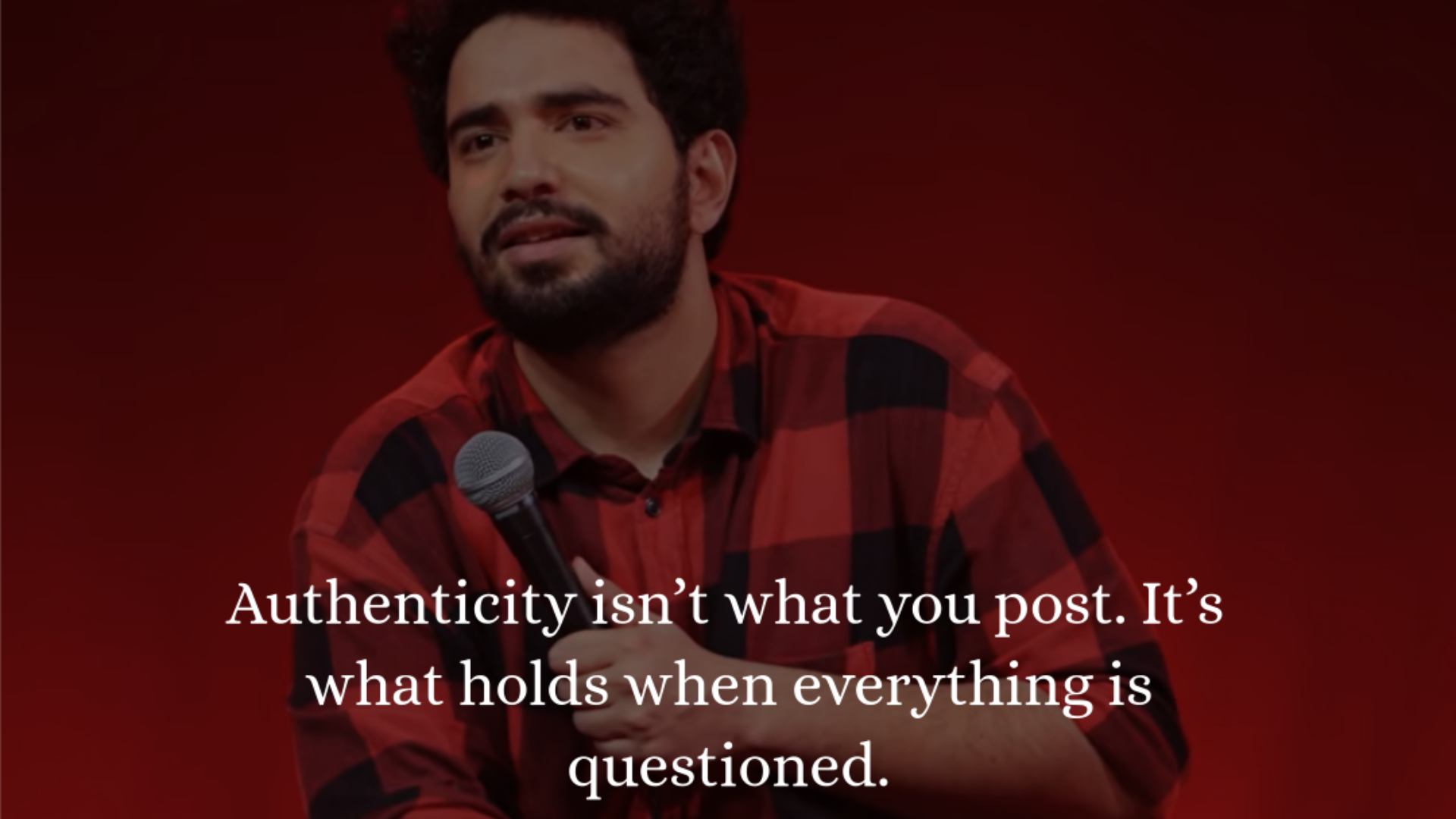
The critique around BeerBiceps, for example, is not about a single action. It is about perceived misalignment between projected identity and lived behavior. Once that gap is noticed, everything is questioned. And when everything is questioned, influence weakens.
4. The Authenticity Paradox
When Samay said he would be his most authentic self but not upload it, it revealed something deeper than hesitation. It revealed a structural incompatibility. Authenticity, in its truest form, is often contextual, unfiltered, and layered. It does not always translate well into formats that are designed for scale, speed, and virality.
Public platforms reward:
- Speed
- Simplification
- Reaction
Authenticity requires:
- Context
- Nuance
- Contradiction
The more authentic something is, the harder it is to compress into content. Which creates a paradox: To be fully authentic may require less visibility. What we are beginning to see is a quiet realization among creators that full authenticity may not be platform-compatible.
And that creates a bifurcation:
- The self that is lived
- The self that is shown
The gap between the two is where credibility is either built or lost.
5. The Future of Content: A Three-Layer Shift
Content is not disappearing. It is reorganizing. We are moving into three distinct environments:
1. Public Content (Discovery Layer)
- High visibility
- Low trust
- Optimized for reach
This is where brands and creators get seen.
2. Semi-Private Spaces (Community Layer)
- Moderate visibility
- Higher trust
- Context-driven
Includes:
- Close communities
- Subscriber groups
- Niche audiences
This is where relationships deepen.
3. Offline / In-Person (Authenticity Layer)
- Low visibility
- Highest trust
- No performance pressure
This is where authenticity is fully expressed. The shift is not from online to offline. It is from performance to presence across layers.
6. The End of Content as Output
Content has been treated as output: More posts + More campaigns + More visibility. But in a world of scrutiny, content is no longer the starting point. Alignment is. Because content is no longer evaluated independently. It is evaluated against, product, behavior, decisions and response under pressure. If these do not align, content accelerates distrust.
7. What This Means for Brands
The implications are not tactical. They are structural. Brands need to shift from:
Communication Strategy → Authenticity Infrastructure
This means:
- Aligning product decisions with brand positioning
- Ensuring consistency across markets
- Building internal clarity before external messaging
- Designing communication that can withstand scrutiny
Authenticity cannot be added at the end. It must exist at the core.
8. The Role of BhaMee Connects
At BhaMee Connects, we operate at this intersection. Not just helping brands communicate better. But helping them align what they communicate with what they are. Because in today’s environment, communication does not create trust. Consistency does. And consistency is not a messaging problem. It is a systems problem.
We are moving into an era where:
- Perception cannot hide reality
- Visibility cannot replace trust
- And content cannot compensate for misalignment
Authenticity is no longer a differentiator. It is a requirement. And the brands and individuals who understand this will not need to defend their narrative. It will hold. On its own.